Sounds like attorney. Isn't one.
It gets you ready for one. Ask in plain English. Drag in the contract, the emails, the photos. The more you give it, the more complete the pack. Simple question free. Full preparation pack $29.
No account. No card. Names and contact details are removed automatically before any AI sees it, though it can occasionally miss one. How
- Reads your documents and builds your timeline
- Lists the time limits for matters like yours and, if your dates are right, when each would fall
- Sets out what the other side may say, and the questions it raises
- Each citation checked against the source text, and the pack says so if a check does not complete
Thirty seconds on a stolen bond.
Ready before your first hour with a lawyer.
Plenty of problems are settled at a tribunal, in small claims or with a free legal service. When you do need a lawyer, it goes better, and costs less, when you arrive organised. Atuny is built for both.
That is the range the NSW Supreme Court uses to assess solicitors' costs: $240 to $480 an hour for an employed solicitor with one to four years' experience, $540 to $900 for a partner. Billed in six-minute units, and much of the first hour goes on you explaining what happened and them reading your emails.
Three hours of reading and preparation at those rates is $720 to $2,700 before anyone has given you an answer.
Supreme Court of NSW, Costs Assessment Guideline (May 2023). Rates vary by firm and state.It reads every document you give it, builds your timeline, finds the law and the deadlines, sets out what the other side may say, checks every citation against the source text, and hands it all back organised, usually within fifteen minutes.
If you need a lawyer, you hand them that pack, which can shorten the first hour. If you use a free service or a tribunal instead, you walk in with the law, the clock and the questions.
Know which kind of problem you have
A bond, a refund, an unpaid invoice, a casual's notice: tribunals and small claims are built for people without lawyers. The pack explains how they work for problems like yours, and names the free services that help.
Know the clock
A missed deadline is the most expensive mistake in law. The pack lists the time limits for matters like yours and, if your dates are right, when each would fall. If one may be close, contact a lawyer, a free legal service or the tribunal now.
See the other side first
A second model, from a different lab, is given the law and asked what the other side in matters like yours commonly argues. You see those points before you walk in, with the questions each one raises.
A question a week
Running a business means a legal question a week. Get the law, the clock and the right questions for each one here for $29, and spend the lawyer's time where it counts.
Any hour, no judgement
Three in the morning, on your phone, the question you'd be embarrassed to ask anyone. The simple one is free, and nothing you type is used to train anything.
Checked, then corrected
A separate check reads each section the pack cites and confirms it says what the pack claims. Anything it cannot confirm is corrected, and if a check does not complete, the pack says so. If you still find one that does not hold, report it from the pack and we review it.
If you do need a lawyer, you walk in with this.
Your facts, dates and documents arrive organised. The lawyer's hour goes on judgement, which is what you are paying them for.
- The facts in order, with dates and amounts
- Your documents sorted and read
- The sections of law that apply, cited and checked
- What the other side may say, set out
- The time limits for matters like yours, and when each would fall if your dates are right
- The questions worth asking them
Why not just ask a chatbot?
Atuny runs on the same calibre of AI models. The difference is what they are allowed to work from, and what you get at the end.
The more you give it, the more complete the pack.
Four kinds of question, from a refund to a boardroom, each asked twice. On the left with nothing but the question. On the right with the documents and the facts. The right-hand one is the one you would hand to a lawyer.
Short answer
Under the Australian Consumer Law a customer has guarantees you cannot contract out of. Whether they can insist on a refund turns on whether the fault is a major failure or a minor one. For a minor fault you can repair first; for a major one, the customer chooses.
The law
Your situation
Laptop sold 14 June 2026 for $2,400 (invoice 2041). On 9 October the customer reported flickering "from about the second week" and said it no longer turns on; she wants a refund by Friday. Not yet inspected. The invoice says refunds within 30 days only.
The law for situations like yours
What the other side may say
The customer may say the product failed well short of the life a reasonable person would expect, which goes to whether the failure is major. Suppliers in this position commonly point to the chance to inspect first, and to any misuse or damage.
Questions to ask
Major or minor failure on these facts, and what follows from each? What can be asked of the customer before an inspection? Does the 30-day line on the invoice create any risk of its own?
Short answer
A landlord can claim from the bond for damage beyond fair wear and tear, but has to justify the amount. In every Australian state the bond is held by a government authority and either side can dispute a claim. Tell us the state and we can be specific.
The law
Your situation
Lease from February 2023 to 26 September 2026. The entry report recorded the carpet as worn and faded. The agent claims $1,980 of the $2,240 bond: $1,450 for carpet throughout, $420 to repaint, $110 for flea treatment. You accept the pet stain in one room.
The law for situations like yours
The clock
A bond claim has to be disputed within the time the bond authority gives; the pack sets out that period and, if your dates are right, when it would end.
What the other side may say
The landlord may say a pet stain is damage, not wear and tear, and that a stain that size cannot be patched invisibly.
Questions to ask
How is the carpet's age taken into account? Is an unquoted repaint recoverable? What happens at the tribunal if the dispute does not settle?
Short answer
A true casual is usually not owed notice, but the label on the contract is not the test. If the person has worked a regular pattern for long enough they may be protected from unfair dismissal, and how you end it matters as much as whether you can.
The law
Your situation
A casual has worked the same three shifts every week for 14 months. The business has 14 staff. The contract gives two weeks' notice either way.
The law for situations like yours
What the other side may say
The employee may say a long run of fixed shifts is regular and systematic work with an expectation of continuing, and that no valid reason was given.
Questions to ask
Does the roster pattern bring this casual within unfair dismissal protection? Does the Small Business Fair Dismissal Code apply at 14 staff, and what does it require? What does a fair process involve?
Short answer
A director has a personal duty to stop the company incurring debts once there are reasonable grounds to suspect it cannot pay them as they fall due. Whether you are there yet depends on the cash position and what is owed, not on how the quarter felt. Tell us the numbers and we can be specific.
The law
Your situation
$310K owed, $118,400 of it past 60 days across 11 suppliers, two on stop-credit. $42K in the bank. A $190K customer payment is due 4 November; the board minutes of 1 October record it as expected at the end of September.
The law for situations like yours
What the other side may say
A liquidator may look for the point when signs of insolvency first appeared and examine every debt incurred after it.
Questions to ask
On these numbers, are there reasonable grounds to suspect insolvency now? Does safe harbour apply, and what does it require? Should an insolvency practitioner look at this, and how soon?
What you get.
A preparation pack a lawyer can pick up and use: your timeline, the time limits for matters like yours, the law for situations like yours, what the other side commonly argues, the documents that usually matter and the questions to ask, every source listed. Six real ones below, each built from the question shown. Click any to read it.
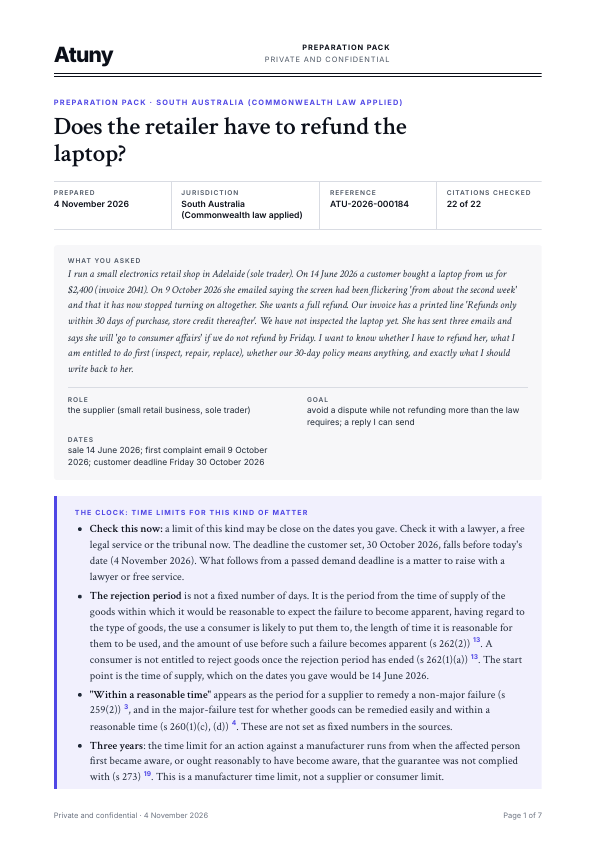
Electronics retailer, South Australia. A $2,400 laptop failed after four months; the invoice says refunds within 30 days only.
7 pages · South Australia (Commonwealth law applied) · PDF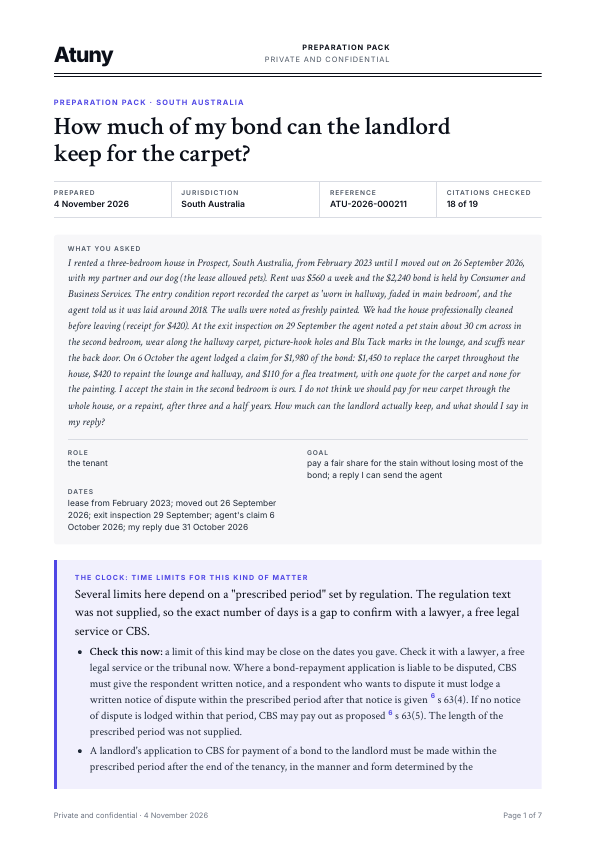
Tenant, South Australia. The agency claimed the whole bond for cleaning and carpet with no quote; the exit inspection was clean.
7 pages · South Australia · PDF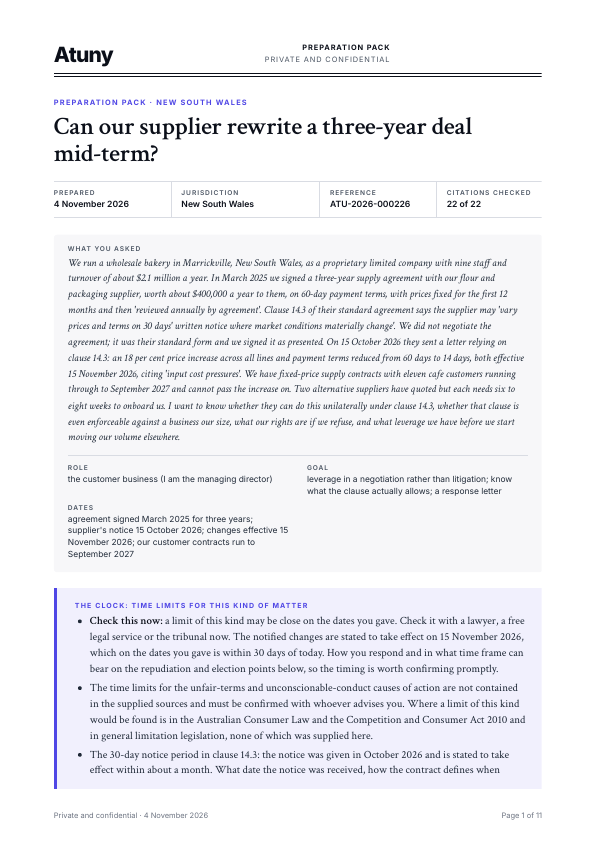
Wholesale bakery, NSW. An 18% price rise and payment terms cut from 60 days to 14 under a 'market conditions' clause.
11 pages · New South Wales · PDF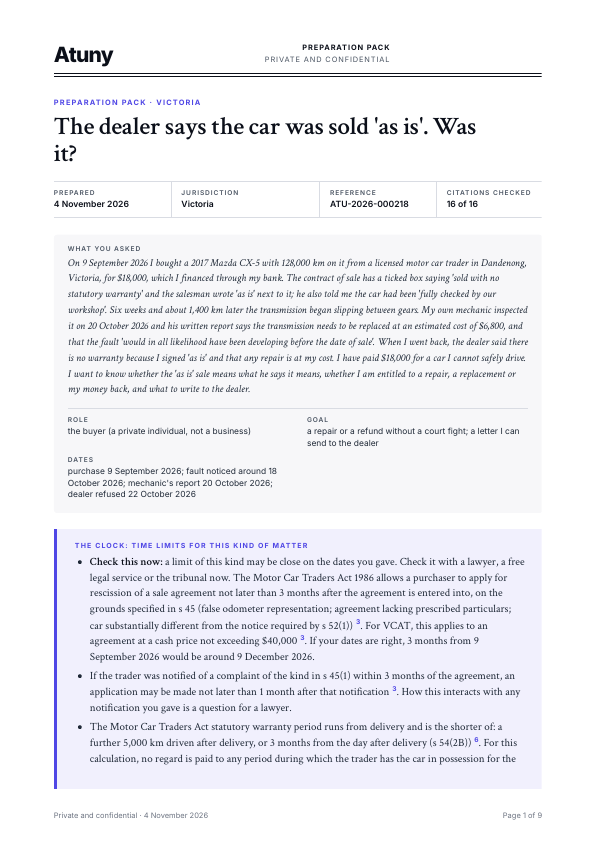
Buyer, Victoria. A $6,800 transmission fault six weeks after buying from a dealer who says no warranty applies.
9 pages · Victoria · PDF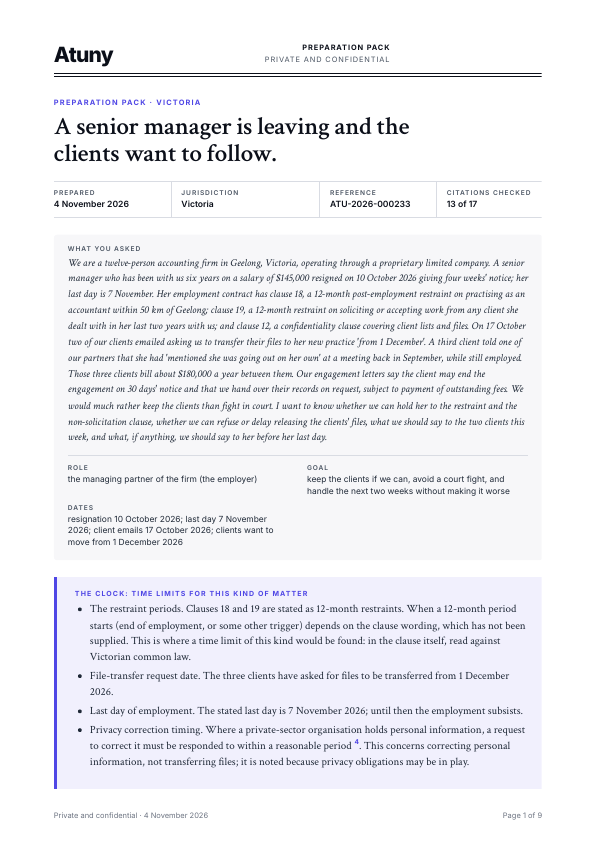
Accounting firm, Victoria. A 12-month restraint, a non-solicitation clause, and two clients already asking to move.
9 pages · Victoria · PDF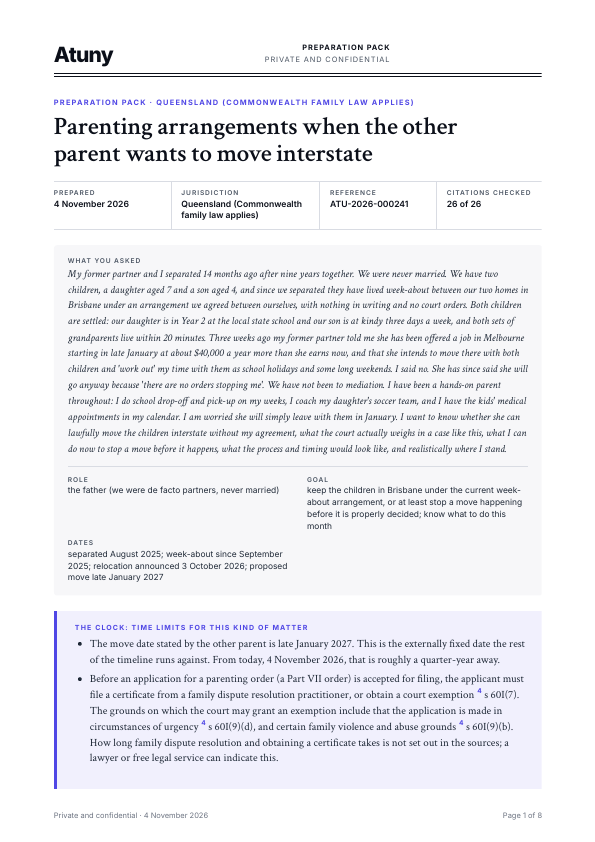
Separated father, Queensland. Week-about by agreement, no orders, and the other parent wants to relocate the children to Melbourne for work.
8 pages · Queensland (Commonwealth family law applies) · PDFEvery one of these was produced by the engine from the facts in the question, with the adversarial pass and the citation check, and rendered exactly as a paying customer receives it.
What it knows.
2.32M sections of law across 17 jurisdictions: 5 countries, 8 Australian states and territories, British Columbia, and 3 offshore financial centres. Each is loaded section by section from the official register or the Open Australian Legal Corpus. These numbers are counted from the database when the page is updated, so the page does not claim more than it holds.
How it stays current
- Checked live at the moment it matters. When a pack relies on a Commonwealth or UK provision, Atuny fetches that section from the official register as it writes, so the pack uses the version in force today and shows its date. If your events were earlier, ask a lawyer whether an earlier version applies.
- Every section is dated. Each source in a pack carries the date of the version it came from, so you and your lawyer can see exactly what it relied on and whether anything has changed since.
- Growing state by state. New jurisdictions and Acts are added from the official registers as they are loaded, and the counts above are taken from the database each time this page is updated.
- It is built to say when it does not know. If the law it retrieves does not answer your question, it is designed to say so rather than fill the gap.
How it works.
Ask
Describe what happened in plain English. The short answer and the law that applies come back in about a minute, free.
Add what you have
The contract, the emails, the photos, the dates, your side of it. Each thing you add makes the pack more specific to you.
Get the pack
Your timeline, the time limits for matters like yours, the law and what the other side commonly argues, cited and checked against the source text, and delivered as a PDF you can hand to a lawyer or a free legal service. $29.
Your matter stays yours.
Legal problems are personal. Atuny is built so the details that identify you stay with us, and the AI only sees what it needs to answer the law.
My landlord Sarah Mitchell wants $1,980 of my bond for the house at 14 Gloucester Street, Prospect. Her agent is on 0412 345 678.
My landlord [Person A] wants $1,980 of my bond for the house at [Address 1], Prospect. Her agent is on [Phone 1].
Your pack comes back with the real names put back in. The amount, the suburb and the dates stay, because the law depends on them.
The AI providers that write the answer are mainly in the United States; identifying details are removed automatically before they receive anything, though the process can occasionally miss one. Read the privacy policy or email privacy@atuny.com.
What it costs.
Ask as many simple questions as you like. Pay per pack, or go monthly for the chat and regular use.
Simple question
- A short answer in plain English
- The sections of law that apply, cited
- An account keeps every question you ask
Preparation pack
- Reads your documents and your facts
- Your timeline, the clock, the law, the other side, the questions to ask
- Each citation checked against the source text
- A branded PDF, kept on your account
- Five follow-up questions included
Atuny Monthly
- Chat with Atuny: up to 500 messages a month, every answer cited
- Up to 10 preparation packs a month
- Unlimited simple questions
- Every pack and conversation kept on your account
- Cancel any time
Prices include GST where it applies. By paying you agree to the Terms of use and Refund policy. Monthly renews each month until you cancel, which you can do any time from your account.
Preparation packs and Atuny Monthly aren’t available in Canada or Singapore yet. Free short answers are.
Law firms and practices: a version built for lawyers is on the way. Email hello@atuny.com.
Questions people ask.
Why not just ask a general chatbot?
Use one for plenty. For a legal question the risk is that a general chatbot answers from its training or from whatever it finds online. It can quote a section that has since changed, apply another state's law, or cite one that does not exist, and it sounds just as sure either way. Atuny uses the same calibre of models but has them write only from the law it retrieves. For every question it retrieves the actual law for your state from over 2 million sections, writes only from that, cites every point to the section, and is built to say so when the law it found does not answer you. For a full preparation pack it also reads your documents to build your timeline, has a second model set out what the other side in matters like this commonly argues, and checks each citation against the source text. You get a document a lawyer can pick up, not a chat transcript.
Is this legal advice?
No. Atuny is not a law firm and nobody here acts as your lawyer. It gives you legal information and organises your situation so you can get advice, or use a free legal service, faster and for less. It does not tell you whether you will win or what to do. For anything that matters, take your pack to a lawyer or a free legal service.
How do I know the answer is right?
Three ways. Every point cites the section it rests on, and the passage is shown so you can read it yourself. A second AI from a different lab is given the same law and asked what the other side in matters like this commonly argues, and what the first one missed. A separate check confirms each cited section says what the pack claims, correcting anything it cannot confirm. A final check looks for anything that strays from information into advice and rewrites it. Checks reduce errors; they cannot promise to catch every one. If you still find a citation that does not hold, report it from the pack and we review it.
Which law does it know?
Australian Commonwealth Acts and regulations, and state and territory law, with more added state by state. Also the United Kingdom, New Zealand, Singapore, Canada (federal and British Columbia), the British Virgin Islands, the Cayman Islands and the Abu Dhabi Global Market. The list under What it knows is counted from the database, so it is never ahead of what is loaded.
What happens to my documents and my questions?
Before anything reaches an AI model, names, street addresses, emails, phone numbers and ID numbers are replaced with placeholders on our own server, and put back in your pack. Photos and scanned pages are read on our server, not by an AI. Your files are read to build your pack and are not kept. Your questions, packs and conversations stay on your account until you delete them, which you can do at any time from your account, one at a time or all at once. Nothing you send is used to train AI models: requests only go to providers that do not train on your data under their published policies.
How long does it take?
A free answer in about a minute. A full pack usually takes five to fifteen minutes, because it reads your documents, sets out both sides and checks every citation. You can close the page: we email you when it is ready.
What can I ask?
Anything that has a legal answer. A customer wants a refund. A landlord wants the bond for new carpet. A supplier changed the terms. A staff member is leaving. The other parent wants to move interstate. If the answer depends on facts you have not given, it says so and asks.
Do I need an account?
Not to ask a simple question. To keep a record, get a full pack or go monthly, you sign in with Google or with your email. No password.
What is the difference between the free answer and the full pack?
The free answer explains which law applies to questions like yours, in a few paragraphs. The full pack reads your documents and gives you your timeline, the time limits for matters like yours, the law, what the other side commonly argues, the documents that usually matter, the general routes and the questions to ask, as a branded PDF with five follow-up questions.
Can I use it for my business?
Yes. It is built for small businesses as much as for individuals: customers, suppliers, contracts, staff, leases and the company itself. Atuny Monthly suits a business with a legal question most weeks.
What if I need more than 10 packs a month?
Buy single packs on top at $29, or email hello@atuny.com and we will scope it with you.
Who is behind Atuny?
Atuny is built and run by Echelon One Pty Ltd, an Adelaide company (ABN 78 618 159 354). Questions go to hello@atuny.com.